I was delighted that my last post picked up a reader in Slovenia. But when I re-read it in the light of that international audience, I saw just how steep a learning curve I am on in terms of international communication.
It was that humour thing that tripped me up. Again. I should know it’s dangerous stuff that I should not carelessly leave lying around. Especially the English variety that is renowned for being incomprehensible to the rest of the world. And I was careless. In my final flourish I decided to embellish my quite serious post about humour with a cartoon. I dug around a bit and found one I thought was quite funny:

One in the eye for the English
Now look at that through Slovenian eyes (or even Thai eyes, Australian eyes, American eyes or German eyes) and it makes no sense at all. This humour truly does not cross cultural boundaries – probably the best reason for using it very warily.
So now as a penance and to share my learning, I will explain why you have to be English to ‘get’ this joke – and hence why it was a disaster in an international communication medium.
Firstly, you have to recognise, simply from the graphic style, that this is from the Bayeux Tapestry, sewn by Norman women in the late 11th century. Don’t ask me why, but most English people would know this straight away.
Secondly, you need to know that the Bayeux Tapestry depicts what we call the Battle of Hastings which happened at probably the one date that we all know – 1066. How crazy is that – it’s nine and a half centuries ago and it’s almost certainly the best known date in English history (except, maybe, for 1966 when we won the World Cup – but that’s another story).
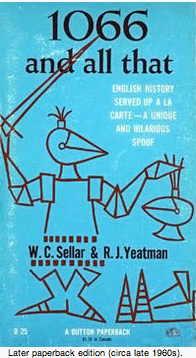
Popular English history begins (and often ends) in 1066
Thirdly, being English, you would also know the Big Fact about the Battle of Hastings is that Harold (the good guy) was killed by an arrow in his eye. (I should be clear at this point that this is English Histopry as she is told, not as it happened or as it has been researched. Actually those Norman needlewoman propagandists have a lot to answer for…)
So If you were English you would get all that from the picture. Amazing.
Fourthly , and turning to the words, you need to know that the most English response to a total and unmitigated disaster of the “I came home from work found my husband in bed with the neighbour’s daughters, I screamed, my dog ran into the road and was squashed flat by a double deck bus” variety is ‘Well, it’s all part of Life’s rich tapestry‘. So crazily bonkers and inadequate that I am laughing already. It seems we love to laugh at calamity, and pretend it just adds colour and texture, and breaks up what might other be a repetive and dull pattern. Crazy, insane. Probably inhuman.
But to an English person, like me, VERY FUNNY.
So now look again at that cartoon – it’s a tapestry, right? With a disaster, yes? And some one is saying (ooh, this is too hilarious!) “It’s part of Life’s rich… (ha ha ha) tapestry!!” Yes! And it’s on a tapestry. (HO HO HO HO.) It shows a collosal defeat for my country that led to years of oppression, which is etched on our national consciousness. That’s right. So we’ll call it a bit of colourful embroidery. (HAW HAW HAW.)
That, my friends, is the English sense of humour laid bare. This is what it’s like to be English.
And it’s why that was such an extremely poor piece of international communication, for which I apologise wholeheartedly. It highlights far, far better than my last post some pitfalls of using cartoons in interpretation.
Question: So what goes hahahahaha – BONK! ? Answer: An Englishwoman laughing her head off!!
(See? disaster, bloodshed, a bit of punning – it’s that English sense of humour again – and I’m giggling like a hyaena!)