Recently I was asked for some advice on how assess interpretation panels. That made me think again about what makes a successful panel.

This panel knows what it is about and makes that clear in words and pictures. That’s all there is to it! KIng’s Park Botanic Gardens, Perth Australia
Panels are very very popular, one of the most popular media in the interpreter’s toolkit. They are also the most criticised. They are hard to get right and there are quite a lot of bad ones about.
I believe a good panel in the right place is a powerful piece of communication. It is worth the work to get them right.
So, what makes a great panel? Two things – rock solid planning and the nuts and bolts of good practice.
A decade or so ago, I thought the nuts and bolts – word numbers, paragraph lengths, text hierarchy and the like – were the most important and wrote about them in How to write a great interpretation panel, a much quoted article for the AHI Journal. (If you want to know more about writing panels and other interpretation come to the A Way with Words course, I run with my friend and inspirational wordsmith, James Carter FAHI, at Plas Tan Y Bwlch in February).
Now, I am older and wiser, I know you can follow all those guidelines and more and still create a panel that is a waste of space, time and money.
A good panel in the wrong place is a bad panel. A good panel written for the wrong audience is a bad panel. Just as a poorly written or designed panel is a bad panel.
Maybe its not surprising there are so many bad panels.
The proof of a panel is in the reading. Ultimately we can’t judge a panel on the screen, or the drawing board. We judge it where it matters – at the interface with visitors. Don’t just just count the words, watch and listen to your visitors and count their responses.

Photographing panels at Scara Brae, World Heritage Site, Orkney
A really good panel comes from a real understanding of your site, your visitors and the relationship between them.
So here are six things I would look for in a really good panel
1. A crystal clear purpose – you have to know what your panel is trying to communicate and how that will add to the way visitors experience and relate to your site. This should underpin everything about the panel. It sounds obvious but so often this is lacking.
2. An interesting or important message – your panel is an interruption into the visit. Is what it has to say worth stopping for? Is it part of the most interesting conversation your visitors could be having here? It needs to be.
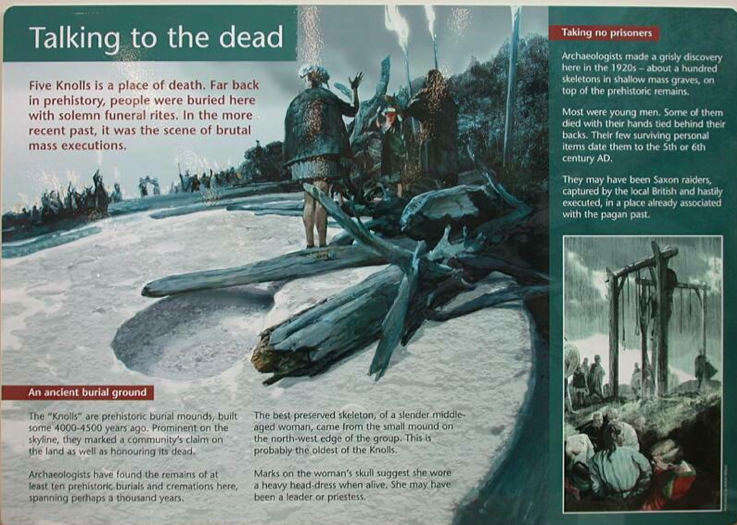
Who would have imagined what a blood-drenched spot this popular urban fringe site is if the panel hadn’t told them. Lot’s to talk about here! Dunstable Downs , UK. (TellTale)
3. Location, location, location – is your panel at the right place to tell people this? Can they see something of relevance here? Do they need this information at this point of the visit? Would it be better later? Or earlier? Or at a point where there is more time/space to linger?
4. A clear voice – your panel represents your organisation, your site, and why both matter. It needs to convey passion, and an unshakeable conviction in the value of whatever it is highlighting. You, the writer, have to have that belief in order to write it.

Probably my favourite ever panel! I will write more about it and why I admire it soon. Leseur National Park, Western Australia
5. Great visuals – put as much of your message into your images as you can. They can convey mood,audience, tone, as well as factual detail. Don’t waste them.
6. Warm and welcoming – through all the above, think about who you are writing for and let that steer how the words and pictures on your panel develop.
Think of your panel is your side of a conversation about something important on your place. Your mission is to pass that conversation into the minds and mouths of your visitors so that they can continue it.
Panels are tough to do well. But they are worth it.
If you would like an in-house training course on ‘Writing with Power, Precision and Passion’ for panels or anything else contact me on susan@telltale.eu or look at the training and mentoring pages on our website